play monster
leslie johnson
On the Saturday afternoon before Mother’s Day, Bethany waits in the long receiving line at Bellman’s Funeral Home in Buffalo. Normally on this day, Bethany and her mother would be on their walk around Harbor Park. It’s their day-before-Mother’s-Day custom. Today, though, instead of strolling around the marina as usual, her mother has insisted on attending the calling hours for Wilson Cisney, who passed away from complications of emphysema. Although not close friends, Bethany’s family and the Cisneys went to the same church, which Bethany’s mother still attends on her own, and it wouldn’t be right, her mother announced to Bethany this morning, not to pay their respects. Annoyed, Bethany mustered a smile and agreed, not wanting to spark tension so soon in the visit.
Bethany visits her mother in Buffalo once a year. Not being a mother herself, Bethany doesn’t mind blocking off Mother’s Day weekend and making the seven-hour drive from Connecticut. They used to spend Christmas together, too, but to be honest, it was a relief when her mother asked a couple of years ago if Bethany wouldn’t mind too much if she instead went on a holiday cruise to the Bahamas with a friend from her pickle ball club. It was a discount cruise—especially for seniors, her mother added, as if afraid that Bethany might try to invite herself along.
Not at all, Bethany had assured her. By all means, cruise away. She couldn’t deny it—their Christmases together had become decidedly lacking in cheer—just the two of them Christmas morning exchanging their small gifts, maybe braving the freezing temperatures to drive to the Waffle House for breakfast hoping it would be something fun, but somehow it never was. They’d return with sugar headaches to the couch, listlessly pecking at the TV remote, never finding anything they both wanted to watch. And inevitably, trapped inside together for too long, her mother would start to reminisce about all the inequities of her long-ago divorce or reference Bethany’s ticking biological clock. Sometimes they’d start to drink and then argue, coming dangerously close to unleashing the old furies.
But Mother’s Day works okay. So far, anyway. Tomorrow, Sunday, they’ll have lunch at the mall and then try on many shoes at DSW, which is also their custom. Bethany always selects a trending sandal for the summer season, her mother a new pair of Skechers. They’ve developed an itinerary that keeps them occupied. And one weekend a year is enough for both of them—enough to verify to themselves that they’re not fully estranged.
In the lobby, Bethany hangs back while her mother signs the guest book atop a marble podium. An usher in black motions them through an arched entryway to the crowded reception room. Mr. Cisney, her mother told her on the ride over, had been a Lions Club president and a chairperson of Pastoral Friends at church before his illness. A well-liked man.
Bethany stands slightly behind her mother in the line; she wonders if it’s her imagination or if her mother is actually shrinking. It happens, doesn’t it, as people get older and the cartilage in their spine wears away? Bethany remembers hearing that somewhere. She looks over her mother’s head, trying to see whether or not there’s a casket up ahead or an urn, but it’s too far away to tell.
Now that she’s here, Bethany regrets it. She’s uncomfortable. She didn’t pack for a funeral, and her striped wrap-dress is too short for the occasion. Her stilettos are sinking into the plush carpet. Before this morning, before this unfortunate change of plans, she hadn’t thought about the Cisneys for over twenty years, and probably never would have for the rest of her life. Now she’s stuck here, in the receiving line. Bethany wonders if she should tell her mother that she’s going to wait in the car, but she doesn’t want to set her off, so she stays put.
There was a short span of time when Bethany had been the Cisneys’s babysitter, her mother said to her this morning. Did she remember?
Yes. Now that she’s standing here, waiting to offer her condolences, she remembers. She recalls Mr. Cisney’s beard and the sleek short haircut of Mrs. Cisney, her angular cheekbones and no-nonsense personality. The freckled faces of the three children—Sophia, Martin, and Emmy—float upward in her memory. Their wispy brown hair and bird-boned bodies. And she remembers that horrible game they played together.
Probably, she tells herself, the Cisneys won’t recognize her anyway, after all these years, but her stomach tightens. What if they do?
She was fourteen when she babysat on Friday nights for the Cisneys, the summer after her eighth-grade year. Mr. Cisney was a professor of history, and Mrs. Cisney gave private piano lessons in their home, an old Victorian near the university. When they went out on Friday nights, Mr. Cisney always wore a blazer and Mrs. Cisney a dress or skirt even though they were only going over to somebody’s house—someone else in the history department—to sit around. Mrs. Cisney called it their salon, which she explained to Bethany was a kind of social club for discussing ideas and controversies of the day. Bethany would ride her bike over at six when it was still light out, and one of the Cisneys would take her home again much later with her bike strapped to a rack above the car’s bumper. They took turns.
Bethany remembers asking Mr. Cisney on one of the drives if he had a fun time. He was driving with his cigarette hand dangling out the window; he puffed and exhaled, letting his smoke blend and billow with the cool air rushing over them both. “Well, we’ve allowed some of the philosophy department to join us,” he said, “so that’s stirred up the proverbial pot. But we tolerate them.” He shook his head and chuckled.
It’s hard for Bethany to remember his face exactly after so many years. She’s thirty-seven now, so that would make it twenty-three years. An eternity. But she remembers the sound of his chuckle and how it made her heart pang—a tiny twist of pain—because she could tell that his real answer was yes, he’d had a fun time.
At that age, Bethany had no parties to attend, no group to belong to. She was a chunky girl with few friends and no clubs or talents to distract her. As a younger child, she’d been a Girl Scout, but at some point her mother wouldn’t take her to the meetings anymore. You’re too old for that now, aren’t you? Her mother waved it away, dismissing it, but that wasn’t the reason. Bethany knew the reason had something to do with the anger filling the air inside their house—charged and pulsing when her parents were both at home, stagnant and stifling when it was just her mother in the master bedroom with the door shut. Tension swelled, pressing against the walls and ceilings. Bethany always wanted to be elsewhere, but she had few places to go.
After church one Sunday, Bethany wrote BABYSITTING in neat block letters on the back of the paper program, her name and home phone number underneath, and tacked it to the bulletin board in the Sunday school hallway. Mrs. Cisney was the only one to respond, but it was a regular Friday night job paying five dollars an hour. It seemed like a decent wad of money to Bethany at the time—sometimes thirty dollars a week. She liked to tell people she was saving for a car. She’d have her license in two years, which was still a long time to wait, but she understood that being able to drive herself away someday whenever she might want or need to was something worth planning for.
“What about you?” Mr. Cisney asked her in return. “Did you and the kids have fun?”
“Yes,” Bethany answered politely. It was true. She had had fun.
Mr. Cisney braked at a stop sign and looked at her. “What did you all do?”
“Oh, we, we played. I played with them.” She felt her face flush and looked down, pretending to adjust her seatbelt.
The car rolled forward, and he didn’t ask her what they played, so Bethany didn’t have to lie. She wasn’t against lying, but at that age, she still tried to keep it to a minimum. She had this idea back then in her youth—a sort of superstition—that you only had so many lies in the invisible bank of lies you could tell in one lifetime before you used them up. After that, you’d never fool anyone anymore. They’d somehow know the truth about you. So she tried to speak in brief but true phrases when she had something to hide but didn’t want to use up a lie.
The Cisney parents did not make it easy for a babysitter. First and foremost, they disallowed television. They didn’t believe in children watching television or playing video games. Bethany wasn’t supposed to even turn it on after the kids went to bed because if they woke up, they would hear it and want to watch with her. There were plenty of interesting magazines and books in the library that she was welcome to peruse. Peruse. That was how the Cisneys spoke. The “library” was a long bookshelf on one side of a narrow room almost completely filled by Mrs. Cisney’s baby grand Baldwin. For activities with the kids, they approved of playing Boggle or building with Legos or dancing to music or drawing on large sheets of blank paper.
Also of issue were the limited snacks. Mrs. Cisney didn’t believe in processed foods, so Bethany was out of luck when scrounging the pantry for Twinkies or Cheez-Its or even pretzel sticks. Mrs. Cisney left fruit cups or sliced vegetables with some kind of slimy orange dip or her dry homemade granola bars for the kids to have at seven, and that was it. By the second week, the middle child, Martin, directed Bethany to climb up on the kitchen counter to reach the highest shelf where a box of sugar cubes was hidden behind canisters of tea and flour and other sundries. They took two each and sucked them away in mutual silence, the dense little squares of sweetness dissolving on their tongues. This was their first secret.
The problem with the Cisney kids and secrets was that if they didn’t all agree on the vice to be hidden, one of them would threaten to tell. I’ll tell, one of them would screech with satisfying power. I’ll tell! Usually it was Martin, the middle child. He was pale and thin like his sisters, but his head was too round and large, his eyes set too far apart. Like an alien, Bethany thought, and she called him Marty Martian once, just joking around, but his sisters joined in, making him mad. I’ll tell! Bethany had to climb up on the kitchen counter again and get him an extra sugar cube.
“I’m the alien,” Bethany said. “And I have to try to capture you and take you away on my spaceship.” It was like hide and seek. Bethany counted in the kitchen as the Cisney children hid, and when she found them one by one, she took them to the living room sofa, which was the spaceship, and covered them with a blanket. “I’m taking you to my planet. When your parents get home, you’ll be gone.”
“No,” Martin shouted, poking his head out, but the girls laughed under the cover.
That was how it started, but the game got better. Instead of an alien, Bethany was a monster. The starting place for the game changed to the attic. The door on the second floor that led up to the attic was locked, but the key was kept in a dresser drawer in Mr. and Mrs. Cisney’s bedroom. The children knew about the key, and the oldest child, Sophia, said they were allowed to unlock the door and go to the attic whenever they wanted. Then why did their parents even lock it? Sophia only shrugged. Were they sure they were allowed? All three of them nodded.
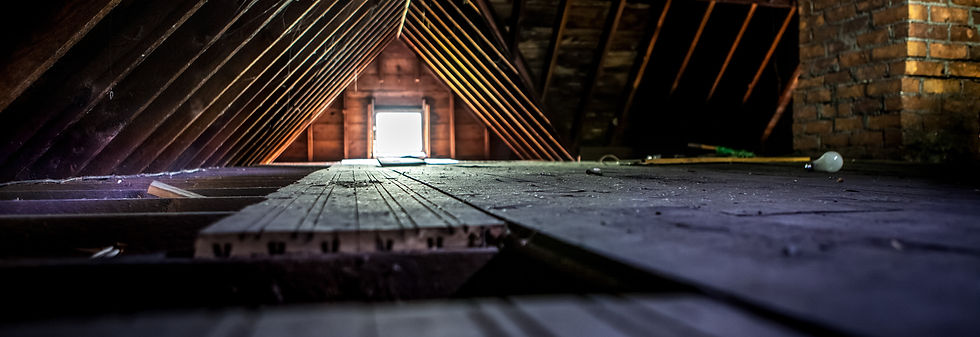
Sophia handed the key to Bethany, and she unlocked the door. A steep, narrow staircase with no railing led upwards to darkness. Sophia held her nightgown above her knees and high-stepped, leading the way, and her younger siblings followed on all fours. At the top, Sophia stood on her toes to reach a cord that clicked on a single lightbulb attached to the slanted ceiling. They moved into the attic space, a maze of haphazardly stacked cardboard boxes. Bethany opened one filled with old clothes and one with books, but in another she found a collection of small wooden totem poles. Bethany picked one up: a creepy cat head with pointy ears, or maybe it was a fox, with white triangle teeth and yellow wings on its rectangle body. She dropped it back in and closed the cardboard flaps.
“There’s bats up here,” said Martin, but none of them wanted to go back down.
One high, narrow window showed the night sky. On that particular night, it framed the half-moon like a painting. They cleared a half-circle on the floor beneath it, pushing boxes around to form walls. They unrolled a small rug with moth holes and sat together, moonglow reflecting in the children’s eyes which seemed to flicker as they stared at her, waiting. Full of anticipation. Bethany could feel it. Her heartbeat quickened.
“You’re orphans,” she told them. “This is your hideout in the mountains. You’re safe here.”
“Why are we hiding?” Martin again.
“Because if they find you, they’ll make you go to an orphanage place where they torture kids and make them work in a factory.”
“Ohhh.”
Who were they? It didn’t matter. None of them asked.
“But the thing is, you have to go down through the forest to get to the pond for water. Because there’s no water up here, and if you don’t get fresh water to drink, you’ll die.”
They children were nodding, hanging on her every word.
“And the thing is, there’s a monster in the forest who hates children. And he hides, and when he hears or smells you, he captures you and takes you to his lair.”
“But we have to get the water,” said Sophia. She gave her brother and sister a direct look, one at a time. “So you have to be brave.”
She gave Bethany a small smile, now her conspirator. In the moonlight Bethany could see the bones of Sophia’s clavicle, the breast buds beneath her pink nightgown. Sophia’s cheekbones were high, her neck slender. She was going to be beautiful, Bethany thought. Sophia was ten years old, maybe too old to play pretend, but in the Cisney’s television-free home, this was the best option. And besides, nobody else would know.
“I’m the monster,” said Bethany.
She and Sophia made up the rules. The pond was the wingback chair in the corner of the living room; the lair was under the piano in the library. The monster could be hiding anywhere in the house, and it could get you coming or going. There was no resisting allowed; if caught you had to do what the monster said.
The first time they played, Bethany left on the light in the second-floor bathroom. It was still pretty dark, but you could see. Bethany hid behind the door of the girls’ bedroom, and when she heard them coming down the attic stairs, she lurched out. The older two gasped and the five-year-old, Emmie, screeched as Bethany grabbed her by the shoulders. “You’re coming with me, child,” she pretend-shouted in a low, gurgling voice. Emmie screamed again, but it was the willing scream of rollercoaster rider; Bethany could tell. After depositing Emmie downstairs under the piano, she hid in the coat closet by the main stairway. She jumped out to capture Martin and then overtook Sophia on the stairs with a swipe on her back, which meant she was caught.
When all three of them were under the piano, Bethany wasn’t sure what should come next. “In the morning,” she said in her monster voice, “I’ll decide which one of you to devour first.” She leaned closer to the huddled children. “Maybe the little one.” Emmie squealed under the shadow of the Baldwin. After that, Bethany sent them to bed. It was already ten-thirty, over two hours past their bedtime, and they all agreed that nobody would tell.
The rules evolved. They started playing in the pitch dark, the light in the attic the only one allowed. Instead of going to the pond all together, the children had to go down one by one. If caught, they could rescue each other by first touching the wingback chair—the pond—and then touching the hand of the captured sibling waiting under the piano and make a run for it together back to the attic.
Every Friday night, within minutes after Mr. and Mrs. Cisney were out the door, the kids started begging for the game. Let’s play monster. How about a board game? Bethany would taunt them. Maybe a few rounds of charades? Play monster, the three kids would start chanting together. Play monster, play monster. And Bethany would hide, listening for the creaks of floorboards in the dark, her pulse racing as she got ready to pounce on them with a bloodthirsty cackle.
Toward the end of July, the Cisneys went out of town for a weeklong family reunion in Michigan. They always stayed at a lake house, Sophia told her happily, with all of their cousins. They had bonfires and boat rides and their own talent show on the last night. While the Cisneys were gone, Bethany found herself restless and miserable, impatient to get back to their Friday routine.
Usually, she captured Emmie first and let Martin rescue her, but then caught Martin on their way to the stairs, letting Emmie run up to the attic on her own, shrieking with delight, while Bethany pushed Martin to the lair. One time he dropped to the floor in protest, breaking the rules, and Bethany dragged him—just for a minute or two—before he stumbled back to his feet. Later on, upstairs with the lights on, Martin showed them all the rug burn on one of his knees, an angry red scrape on his freckled white skin. “I’m going to tell,” he said, narrowing his ET eyes into slits. “I’m going to tell that you were chasing me in the dark with all the lights turned off.”
“Shut up, Martin,” said Sophia, and Emmie echoed her, “Yeah, shut up, Martin.”
The girls were on her side. Bethany felt empowered, maybe even loved.
“If your mom notices your knee tomorrow,” said Bethany, “just tell her it happened at school. On the playground.”
Then wordlessly, all of them understanding the next step of negotiation, they walked downstairs together to the kitchen, where Bethany climbed up on the counter for the sugar cubes. “Just one,” she said to Martin. She was getting worried that one of these days Mrs. Cisney would notice the diminishing number of cubes. As she passed them out, they heard the rumble of the Cisneys’ car pulling into the driveway.
“Run,” Bethany ordered, and the children fled. The sugar box was still in her hand, and her gut twisted as the car advanced along the side of the house on the gravel driveway. She had no choice other than hoist herself back onto the counter to stick the box of sugar back onto the highest shelf, but then the Cisneys were coming in the back door, which led right into the kitchen, and Bethany was standing on their kitchen counter. Caught. She swallowed the half-cube in her mouth, a sharp grainy corner of it scraping her throat on the way down.
“What are you doing?” Mrs. Cisney brought one hand to her breastbone. It was a warm August night, and she was wearing a slim blue shift with a scooped neckline, her hair tucked behind one ear with a pearl earring. In that moment Bethany wished that Mrs. Cisney were her own mother and that Bethany could have tearfully confessed about the stolen sugar and be forgiven. Even if there was a little lecture about cavities or calories or honesty being the best policy, Bethany wouldn’t have minded. She wouldn’t have needed to use up a lie.
She told them she was just getting a tea bag, gesturing to the box of Earl Grey on the high shelf. She was standing there awkwardly on the counter looking down at them. She said she was sorry, that she should have asked them ahead of time if it were okay for her to have tea. She felt ashamed of her body, clumsy and fat, as she lowered her rear onto the counter and shoved herself off with a thud as the Cisneys watched.
“Tea? Of course you can have tea,” said Mr. Cisney, slurring his words a little. His cheeks above his beard line were flushed. It was his wife’s turn to be the designated driver, and Bethany admired the way two of them worked as a team in this way. He said, “Next time we’ll leave it on the counter for you.”
On the drive home, Mrs. Cisney was quieter than usual. Bethany tried to redeem herself by praising the children, how nice and cute and smart they were. “Martin knows a lot about science,” she said, hoping that were true.
“About the tea,” said Mrs. Cisney. “I’m not sure it’s a good idea. It’s a gas stove, a very old one, and I know you most likely wouldn’t, but if you left a burner on by mistake, it could be dangerous. Even if it’s a one percent chance, I just wouldn’t want to have to worry about it.”
“I don’t need tea,” Bethany said. “I won’t make any tea.”
When Mrs. Cisney pulled into her driveway, she said, “It’s so dark. Your parents should leave the front light on for you.”
Bethany felt the sting of her criticism. “I’m sorry about the tea,” she said again, but Mrs. Cisney didn’t say anything.
All week she worried that Mrs. Cisney didn’t like her anymore and wouldn’t want her to come back. She would never admit it to anyone, but the monster game was the best part of her week, the most fun thing she had. She thought about it all the time, making up new rules and scenarios in her mind. It was summer, and Bethany had nothing else to do. She watched hours of television and for exercise rode her bike to Kwik-Mart and bought bags of Swedish Fish and Circus Peanuts. That same week that Bethany was worried about the tea incident with Mrs. Cisney was also the week her mother started emptying closets.
It was Tuesday or maybe Wednesday, and Bethany was watching her morning shows in the family room when her mother came in and started cleaning out the game closet. That’s what they called the big downstairs closet with accordion doors even though it held only a couple of games that nobody played. Scrabble and Chinese Checkers. Also Twister, which her Aunt Joy had mailed to Bethany for one of her birthdays. Once Bethany spread out the thin plastic mat covered with rows of colored circles and tried it out by herself—right foot red, left hand yellow—but that was it. Mostly the closet held junk that nobody used but had never thrown away: a broken blender, a never-used crock pot, extra bedding, Bethany’s old Girl Scout sleeping bag and canteen. All sorts of stuff. Bethany was shocked. Her mother wasn’t much for housekeeping. She cooked dinner sometimes and did the dishes and occasionally vacuumed.
But this closet thing was different. Bethany, surprised, offered to help. She wanted to help, but her mother waved her off, saying no, that was okay, honey, thanks, but she just needed to get everything out and see what was what. But once everything was out, she left it all scattered around on the family room floor. Her mother was breathing hard, and her eyes were open too wide, Bethany noticed, as if her eyelids had completely dissolved. She flung open the coat closet, yanking and flinging everything off the hangers until piles of jackets and boots and flip-lops and sunhats and canvas bags blockaded the hallway. And then the closet in the downstairs bathroom, and then the kitchen pantry. At some point, her mother retreated to the upstairs bedroom, slamming the door. The downstairs looked ransacked, as if someone had been desperately searching for a hidden treasure that refused to be found.
When her dad came home, Bethany waited to see what he would say, but he just stood in the middle of the mess and closed his eyes. Bethany was terrified. There were so many more closets in the house upstairs, and drawers and dressers, too. What if she kept going? Bethany wanted him to tell her not to worry, that he’d take care of it. But he just clicked his tongue at her then squeezed his lips in, as if Bethany were the one annoying him at the end of his workday. As if somehow the mess was all her fault.
The receiving line inches forward, slow as molasses her mother keeps muttering in Bethany’s ear. People aren’t supposed to ramble on so long to the poor grieving family members, she whispers. Don’t they know it’s not appropriate?
Bethany unzips her cross-body purse—a new one from Lululemon—and pops a breath mint, craning her neck to the see the where the line ends. They’re at the halfway point, she estimates. They reach another one of the photo display monitors, where pictures of Mr. Cisney and his family slowly rotate. She recognizes him in the photographs immediately and fully, as if he’d been a close friend: his beard and thick brows and alert eyes, his expression of wry amusement. There is a wedding photo of him and Mrs. Cisney being pelted by rice as they run down the steps of a church looking ecstatic, terrified, or some combination. In one of the family portraits, the children are teenagers, Martin wearing a buttoned-up polo and posing with his hand on the shoulder of Emmie, who grins widely, unashamed of her braces. Sophia stands beside her mom, their smiles identically moderate and self-possessed. Mr. Cisney beams at the camera, as if amazed at his good fortune to be among them.
The day after her mother’s incident with the closets, Bethany now remembers, she helped her father shove everything back into them while her mother cried in the bedroom. They could both hear her up there, but her father ignored it, so Bethany did, too. The next day, her mother went on a trip with Aunt Joy, who’d driven from New Hampshire. Her father put a packed suitcase in the trunk of Aunt Joy’s car. Just a little vacation, he told Bethany, to spend time with her sister. He took the next day off from work to stay home with Bethany, which surprised her. She told him it wasn’t necessary. I’m a babysitter, Dad. I don’t need one. But she was glad about it. He made them scrambled eggs and toast, and they sat at the table together.
And that’s it, Bethany has told her therapist on more than one occasion. Her best memory of her and her dad. Which is pathetic, isn’t it? Her mother’s “vacation” was extended, then extended again, and nobody explained to Bethany that her mother was actually being treated at a psychiatric facility. A nice one, her mother tried to reassure her years later when Bethany finally figured it out. No Nurse Ratcheds or anything like that. When she returned home, they all acted as if nothing had happened. Two years later, during Bethany’s junior year of high school, her parents divorced in the same tight-lipped manner. Bethany stayed with her father to finish high school, and her mother moved back to her old hometown of Buffalo. When Bethany finally got away to college, she loved the noisiness of the dormitory and the parties and the boys who didn’t know what she used to look like. She barely graduated and always assumed that someday she’d end up with a big, noisy family of her own because that’s what she wanted, and she’s trying to figure out these days why that never seemed to happen.
In front of her, the Cisneys’ photos roll on and on with endless abundance. Someone behind her clears their throat, and Bethany steps forward again into the gap.
On the Friday after her mother left, Bethany rode her bike to the Cisneys as usual. She got there early and parked her bike with its kickstand on the back porch. It was a beautiful evening, still perfectly light outside, and the kids were playing in the yard after their dinner, which Mrs. Cisney always served them early on Fridays. They waved to Bethany, calling her over, but Bethany sat down on the porch, telling them just a minute. They were playing bubbles, Sophia dipping an oversized wand into a pan of bubble soap and waving it slowly to make giant, shimmering orbs that floated above the heads of Emmie and Martin, who jousted with a pointed stick, shouting “Hi-yah,” when he popped one, while Emmie shouted in her loud voice, “That was mine. It was my turn!” But then she would just laugh and race circles around her big sister, waiting for the next one.
Bethany watched them, feeling her chest tighten with envy.
That evening after Mr. and Mrs. Cisney departed, Bethany made the children color at the kitchen table. “I’m tired,” she told them.
“This sucks,” said Martin. “We want to play monster.”
Bethany gave in but told them only until nine. She wanted to make sure nothing was wrong this time when Mr. and Mrs. Cisney got home. She turned off all the lights on the first and second floor as the children climbed up to the attic. “Urrrgggg,” she groaned into the open attic doorway, and listened to them giggle and whisper. She closed the door. She felt an irritating surge of jealousy and anger, and she stood there for a while, fingering the key to the attic door in the pocket of her jeans. She always returned it to the drawer in the Cisneys’ bedroom as soon as the game was over. It occurred to her that she could lock them all in the attic right now and make them beg the monster to set them free. Maybe they’d bang on the door and start to cry while she sat here in the darkness, making them wonder.
But she didn’t. She hid downstairs and played the game half-heartedly, capturing the children and letting them rescue each other. But the second time she captured Martin, she put him in the hallway closet where the Cisneys kept their broom and vacuum cleaner. She shoved him in and shut the door and stood with her back pressing against it to keep it closed. “No fair,” he yelled. “This isn’t the monster lair. It’s not the rules.”
“Monster makes the rules,” Bethany said in the monster voice.
For a minute it was quiet. Then the doorknob starting twisting again, Martin’s body banging against the door, his enraged voice shouting, “No fair!” Bethany waited and then stepped away, letting the door fling open and Martin tumble out onto the floor. Bethany moved silently in the pitch dark to the coat rack, which was strung with the kids’ oversized pool towels. She waited behind it, breathing in the chlorine from their swimming lessons. She closed her eyes and felt herself underwater. She heard Martin stepping toward the living room, to the fresh water of the pond that would keep his sisters alive, his feet running now back toward the staircase and Bethany leapt out in front of him, landing in a wide squat, and just before he reached her, she opened her mouth and let out a guttural howl. Martin screamed, and something jabbed Bethany’s shoulder. She screeched in surprise, and then pain quickly spread around her shoulder socket. Something clattered on the floor: the broom. Martin had stabbed her with the broom handle.
“You little shit.” Bethany lunged for the light switch by the stairs, and Martin blinked like a possum in the sudden glare of headlights.
“You broke the rules.” His lower lip started to quiver, which made Bethany want him to go ahead and cry.
“You ruined the game,” she said. “Nobody in your family even likes you.”
“You can’t say that. You’re the babysitter. You have to be nice to us.”
“I didn’t say anything.”
“Yes you did.” Martin stomped his foot for emphasis.
“Prove it,” Bethany hissed.
Soon the girls clamored downstairs to see what was going on, and Bethany told them that Martin had attacked her with a broom. The evidence, the broom in question, was on right there on the floor, and Bethany pulled on the neck of her t-shirt to show them the mark on her shoulder already becoming a bruise. She sighed and lifted her arms, palms upward, indicating that it was now a done deal. “Game’s over,” she said. “Time for bed.”
“No,” said little Emmie with her big voice. “It’s early. We want to play.”
Sophia said Martin would apologize and he would skip his next turn, okay? Bethany deliberated, tapping one toe. She said Sophia and Emmie could keep playing, but Martin had to be dead. “The monster killed him,” Bethany said. “And he’s buried in the lair. He has to be dead the whole time.” Martin protested, but Sophia told him he had to because he’d hit the babysitter, and he couldn’t just do that. It was decided. Bethany went up to the attic and brought down an armful of the wooden totem poles. They buried Martin under the piano, covering him with a crocheted throw blanket. Bethany placed the totem poles around his body like evil spirits, the creepy fox-bird by his head. Then the girls went upstairs, and Bethany turned out all the lights.
“You’re dead,” Bethany whispered to Martin.
“I hate you,” Martin whispered back.
Then Bethany went to hide. She caught Emmie on the second floor and brought her down to the piano. “Do not speak to the boy,” Bethany said in the monster voice. “He cannot hear you. He has gone to the afterworld.”
“I want to Sophia to save him,” said Emmie. She sounded excited, which irritated Bethany. Emmie was smart enough to understand the new rules.
“She can’t. He’s gone now, and she can’t bring him back. Nobody can. It’s too late. It’s impossible.” She realized she’d stopped using her monster voice, but for some reason her regular voice made Emmie start to whimper.
Bethany had to leave the lair now—that was the rule of the game. She went to the kitchen and crouched under the table, waiting for Sophia to touch the pond and then Emmie’s hand, waiting to jump out and chase them as they ran back to the attic. She heard Sophia’s pattering footsteps, and then Emmie’s voice: “Save Martin, too.”
Sophia whispered something that Bethany couldn’t hear, and then Emmie was wailing. “I don’t want Martin to be dead anymore.”
“Okay, okay.” Sophia started turning the lights on, and she found Bethany sitting cross-legged under the kitchen table. From the library Emmie cried noisily.
“Martin has to be alive now,” Sophia said. “Emmie’s too freaked out.”
“That’s not the game.”
“So what?” Sophia put one hand on her hip, straightening her spine in just the same way as her mother, Mrs. Cisney.
“You have to go to bed anyway,” said Bethany, still under the table. “It’s time.”
Sophia’s mouth twisted to a sneer.
“If you don’t,” said Bethany, “I’ll tell.”
Sophia gathered her brother and sister and took them upstairs. Emmie, usually so happy-go-lucky, was still whimpering. Bethany sat in the wing chair in the living room trying to read one of the Cisneys’ Smithsonian magazines till they got home.
On Sunday while Bethany was riding her bike to Kiwk-Mart for gummy worms, Mrs. Cisney called. Her dad gave her the message later that afternoon. The Cisneys wouldn’t need her to babysit on Friday. Why? Her father shrugged. He guessed because they weren’t going out. This Friday or any Friday? Bethany demanded to know. Another shrug. He said, “They’ll call you if they ever need you again in the future. That’s what she told me.” Bethany’s cheeks were on fire. Her heart pounded like it did in the darkness during the monster game. Who was it that told? It could have been any one of them. Sophia, or Martin, or Ellie.
It wasn’t till later that night, in bed, when she realized she could have done it to herself. Those totem poles. She’d totally forgotten to put them back in their box in the attic. Instead, they were under the piano, maybe knocked askew by Martin when he rose from his deathbed, left there in a ghoulish array. The largest one perhaps still standing: the angry fox with those sharp teeth and yellow wings and accusing eyes. Bethany imagined Mrs. Cisney going into the library to get ready for her first piano lesson and finding them there, then questioning her children. Who did this? Who put these here? And the children would have to declare their innocence. It wasn’t them. It was the babysitter.
The coffin is closed. Bethany can see it now. A thick aroma wafts from many large floral arrangements, and Bethany’s eyes start to water. On the other side of the casket, the Cisneys are shaking hands and nodding. They must be exhausted, thinks Bethany. She heard the couple behind them in line say to each other earlier that Wilson Cisney’s passing was a blessing at this point, a relief after all this time, so apparently Mr. Cisney’s death was long expected. They’re all standing up straight and earnestly greeting each person in turn. Properly stoic.
The line comes to another standstill, and Bethany has the urge to adjust her mother’s wiglet that’s slipped slightly out of place on the crown of her head where her hair has thinned. She lifts her hand but stops herself before touching the hairpiece; her mother would be embarrassed to have Bethany poking at her, especially in public. She feels a sudden rush of tenderness. For the last fifteen years her mother has clung to her own mental wellness the best that she’s able. Bethany knows this.
They’re getting close now. The children are shoulder to shoulder, and Mrs. Cisney stands a foot or two beside them at the end of the line. Someone is hugging Mrs. Cisney by the shoulders and whispering at length in her ear. Bethany’s mother turns her head to Bethany and rolls her eyes. When it’s finally their turn, her mother follows her own advice and keeps her condolences brief. I’m so sorry ... What a wonderful man ... A beautiful legacy.
Standing in front of Sophia, Bethany finds herself suddenly flustered. “I’m her daughter,” she manages to say, pointing with her thumb like a hitchhiker at her mother, who is now giving Mrs. Cisney an appropriately brief hand squeeze, saying, “Barb, there are no words.”
“Thank you for coming,” says Sophia wearily but politely. Her brown hair is short now, and crow’s feet frame the edges of her hazel eyes. They’re both women in their thirties now, after all.
Bethany moves to Martin. He’s wearing a twill blazer like his dad always used to, and Bethany wonders if maybe it is one of his dad’s old jackets worn in his memory. Martin’s body has grown into proportion with the large, round head of his childhood self, his neck and shoulders now thick and muscular. If they weren’t at his father’s funeral, she’d ask him if he lifted weights. She says, “Your dad was such a nice person,” and ridiculously, tears well up in her eyes.
He studies her face. “Are you from the church?”
She can feel her tears starting to brim and tries to will them away. It’s embarrassing. They don’t even know each other, really. “I used to be. When we were all kids.” Bethany quickly forces a smile. “I was your babysitter.”
Emmie is next in line, with a boyfriend beside her who’s wearing a dress shirt and tie. Of all of them, she looks the most like her childhood self: petite and elfish, her pointy chin and pretty eyelashes. “Oh my god,” Emmie says suddenly, and her voice is too loud. Martin nudges her with his elbow.
“I remember you,” Emmie says to Bethany. Her eyes are bloodshot, and tears have left dried rivulets in her makeup, but she’s smiling. “You’re the monster. Martin, do you remember? She was the monster.”
Bethany feels her face turn hot. “I was a terrible babysitter. The worst.”
Martin says, “Your hair.”
Bethany touches the blond waves curling around her shoulders. “I color it now.”
“That game,” Martin says, widening his eyes at her.
“I’m so sorry. They shouldn’t have let me near kids. Haha.” Bethany laughs a fake laugh, feeling mortified.
Martin’s forehead creases and he tilts his head. Remembering something, Bethany can tell. “What?”
“I made you cry,” he told her. “You were trying to push me in a closet, and I kicked your shin really hard. I think I called you some kind of terrible name or something and you started to cry.”
“I did?” She doesn’t remember that. She doesn’t remember herself ever crying. “But the closet.” She presses her hands to her cheeks.
“We were just playing the game, and I was being a brat, most likely.”
Sophia leans in and touches Bethany’s arm. “The monster game, right?” She’s smiling at Bethany now, too. “Oh, wow. We loved that game. It was so creepy! We tried to play it a couple times without you, but it was never the same.”
“You were our favorite,” says Emmie. “What’s your name again?”
“The monster,” Bethany says, growling, the old voice from the Friday night game coming back to her on cue.
The three Cisney children laugh softly together and Bethany joins them, these now-adults who grew up knowing they were loved and lovable. On the way out, Bethany thinks, she’ll stop and sign the guest book. Then Emmie’s laugh turns to a sniffle, and she fans her face with one hand. “Don’t worry, I’ve been like this all day. Waterworks off and on. I’ll be fine.”
By instinct Bethany reaches over and touches Emmie’s shoulder. Bethany’s mother has stepped out of the line, waiting for her, and Bethany can feel her disapproving stare boring into her temple. Bethany is holding up the line, causing a jam. She’s being inappropriate. But she doesn’t move. Her hand still rests on Emmie’s shoulder. Bethany opens her mouth, wanting to say just one more thing before she leaves, but the words stick in her throat, a cube of hard sugar caught in her windpipe.
Leslie Johnson’s fiction has been broadcast on NPR, selected for anthologies, and published in literary magazines including The Threepenny Review, Colorado Review, Third Coast, december, Cimarron Review, and Fictive Dream. Her stories have received the Pushcart Prize (also appearing in a “best of Pushcart prose” anthology, Love Stories for Turbulent Times) and the Three Sisters Award for fiction from NELLE literary journal. Leslie teaches at the University of Hartford and conducts writing workshops for the Connecticut Office of the Arts. She’s a recipient of several CT State Literary Arts grants.
