in the muskgrass
alan p. marks
“Seeing stars,” most people call it, that phosphene glow from when you bang your head hard, or when you stay underwater longer than you should, holding your breath for too long.
The way you are now, sitting cross-legged on the bottom of the pond.
To you, it never looked much like stars, though. The stars don’t move, at least not that you could tell when you look at them. They just hang there in the sky, far away and unreachable. Unmoving, like the motes of sun-kissed silt that float in the water around you.
No, you think of it more like the swirling cascade of light from that big bag of sparklers your mother bought a few summers ago, a week or so after the 4th of July when all the leftover stuff had gone on sale at the store where she worked in order to make room for back-to-school, even though school was still months away.
She’d felt guilty because she was too afraid to take you out in crowds where people might brush up against you and notice something strange, so she hadn’t taken you into town for the special fireworks display they put on that summer for the town’s bicentennial.
You told her you didn’t mind, that you didn’t want to go anyway. Which was sort of true—you don’t much like crowds either. But she still felt bad about it and tried to make it up to you with that giant bag of discount sparklers that the two of you staked out all around the little yard back behind your house, way out near the town line by itself as if it, too, didn’t much like the idea of others coming close and bumping up against it and learning its secrets.
And then, after the sun set, the two of you rushed around the yard, a lit sparkler in each hand, laughing as you used them to light the ones you’d stuck into the ground everywhere, seeing how many you could get going at the same time before the first ones burned down and out and disappeared in the dark. While they burned, the air all around you was alive with light.
The way it seems to you now as—smiling at the memory—you float slowly upwards, towards the surface of the pond.
You don’t recognize the girl that day, when you see her for the first time. The girl with the bright pink hair and weird-ass haircut standing at the edge of the pond. Right next to the pile of your clothes.
Which is strange—the fact you don’t recognize her—in a place where everybody knows just about everybody else, even if you do tend to keep mostly to yourself. So, she must be new to town, since school only let out for summer the week before and there’s no way you could ever have missed that hair.
She looks more or less your age, though it’s hard to tell for sure, what with the baggy t-shirt she wears, and the faded jeans that have to be at least three sizes too big. It’s a wonder they don’t fall down.
Standing there, leaning back against the old oak tree on the bank at the water’s edge, she smirks at you. You can see it on her face from where you float all the way out in the middle of the pond, only your eyes and nose poking up out of the water like, if you stay down low like that, maybe you can pretend she doesn’t see you.
The blood rushes in your ears and you’re having trouble catching your breath, but you’re not sure whether that’s from having stayed underwater for too long—at least a half an hour this time, a new record—or because she looks like she’s been standing there watching and waiting this whole time.
Maybe it’s because you aren’t wearing anything.
She must sense your panic because that smirk fades and she gives you a hesitant little wave instead, a twitch of the hand at her side so slight you might have missed it if you weren’t looking right at her. When you don’t wave back but also don’t disappear back under the water like a spooked fish, she steps out from the tree and starts to undo the belt that you now see is what’s holding up those ridiculous pants.
You almost do dive back underwater then, suddenly afraid she’s coming into the pond with you and there’s no way she won’t find out your secret if she does.
And, if she, does, then everyone will.
Only she makes no move down the bank towards the water. Doesn’t kick off her shoes. Doesn’t step out of those jeans at all but only pulls them low enough to reveal the shorts she’s wearing underneath.
You forget all about the safety of the pond, forget your nakedness, forget about hiding. Forget everything when she turns sideways just enough that you can see the beginnings of the long, slender tail that sticks out through a hole cut in the back of her shorts, can see it as it uncoils from around the girl’s leg and pulls itself up out of those—understandably, now—baggy jeans.
Your heart pounds even harder, till it’s the only thing you can hear, and you slowly kick your way closer towards the shore until it’s shallow enough for you to feel your toes start to scrape bottom. You crouch there, watching the girl. She doesn’t move, except for that impossible tail waiving back and forth behind her.
Now it’s the girl who looks about to panic, like she’s the one ready to break and run away. Before she can, you close your eyes and take a deep breath as if steeling yourself to plunge into icy water. You force yourself to stand, just enough for her to see you from the waist up.
You turn a little to one side, unconsciously echoing her stance, in order to give her a better look and, when you don’t hear anything, you open your eyes. She’s staring at you, a smile on her face.
You feel one stretch across your own.
“Cool,” the girl says.
The girl calls bullshit on you when you tell her you remember being born.
It’s a drizzly early-summer day, and you’re sitting together on the bank at the edge of the pond under the cover of the old oak. Its branches stretch far out over the water, shielding you both from the worst of the rain. The ragged bark of the tree trunk digs at your back, and water worms its way through the branches, dripping onto your head or into your eyes or down your shirt when you least expect it. Better to be right out in it or, better still, floating in the pond, just below the surface, listening to the steady hiss of the rain as it splashes into the water above.
Only the girl doesn’t swim. Doesn’t much like water at all. Sinks like a stone, she told you the day you first met.
Besides, it’s easier for the two of you to talk like this, sitting next to each other, even if you can’t look at her without being obvious about it. You can picture her, though, the short hair, dyed bright pink with streaks of orange you only notice when you’re up close, shaved close on one side and longer on the other. The t-shirt. Some band on it. Always some band, most of them you’ve never heard of. The shorts with the hole cut in the back.
And there’s something about the metallic, petrichor smell of new rain and the way your shoulder feels warm from where it almost-but-not-quite touches hers.
It’s only been a couple of weeks and you’re still feeling each other out. She talks about how she’s lived all over the place. How her family moves around a lot because . . . well . . .
You talk about how you’ve never lived anywhere else but here, but you and your mother, you pretty much keep to yourselves because…well…
Her parents are both like her, she tells you, and you watch as she reaches out and grabs a rock with one bare foot, the big toe like a thumb, grips it, and tosses it backhand (backfoot?) into the pond. Her beat-up old sneakers are somewhere behind you on the far side of the tree, along with her jeans, forgotten and probably soaked through from the rain by now. Oversized and blown out in the sides, she only wears the shoes when she’s around people. People other than you, anyway.
There’s a tap on your shoulder—the one on your other side, away from her—and you turn to look. The oldest joke in the book, and you laugh when you see the tip of her tail there, giving you a little wave. Up close like that, you notice the fine layer of peach fuzz that coats it.
It looks soft to the touch.
You tell the girl that your mother isn’t the same as you at all. Not so’s you can see, anyway. That she takes after her own mother, so can pass for normal. And your dad was just some regular guy, which is why you can’t stay underwater as long as you want, no matter how much you practice. Not like your grandfather could. Not with all your mixed blood.
You never actually knew your father, you tell her. The way your mother explained it once you were old enough, one night she told him she was pregnant . . . and then never saw him again. But he wasn’t such a bad guy, you insist. That seems important to you for some reason. Your mother just said they hadn’t known each other all that long, and she did kind of spring the news on him out of the blue. Maybe if she’d waited a while longer to tell him. Broken the news more gently.
The girl asks if you think your mother did it the way she did on purpose. To scare him off.
You shrug. Maybe. She might have been protecting you, even back then.
Either way, that’s why she was all by herself when you were born—because, well, not like she could go to a hospital, not knowing what you might look like when you came out—and when you tell the girl you remember it, she laughs and “bullshit” bursts out of her like a cough she can’t stifle.
Suddenly, you’re annoyed by how the tree makes your back itch, and the way the dripping water leaves you chilled in some places while you’re still hot in others, and you slide the few feet down the bank and into the pond, push yourself out from the shore. Push a little too hard, maybe, and you hope the girl didn’t notice.
You do remember.
Not the run-down motel your mother told you about when you asked her where you were born, just off the highway somewhere between Virginia and Mississippi. Even she wasn’t exactly sure where, only that it was cheap and was fine taking cash as long as she paid up front. Not the stained carpet or yellowed bedsheets, or the blare of trucks from the highway that kept her awake for three nights in a row, or the smell of mildew mixed with disinfectant in the bathroom where she climbed into a tub full of warm water when the contractions got too bad.
But you do remember that water, warm and cloudy and tinged red, and the harsh light glaring down from somewhere overhead. You remember the dark blur hovering over you, and the pressure on your chest, gentle, but steady. Insistent. How it pushed you down into the water and held you there, and held you there, and held you . . . until the pressure inside your tiny body became even more insistent than the one that kept you beneath the surface. Until you finally opened your mouth and pulled that warmth into you. And then out through the row of thin slits that ran down your sides.
And then in again. And out.
You remember the pressure easing, inside and out, and that blurry shape coming in closer and shielding you from the glare. Shielding you from . . . everything. Remember floating there in the shadow of that shape you didn’t yet know was your mother, and how good it felt. How safe it seemed there, under the water.
“That’s dead water,” you say to the girl one day when she tries to get you to go exploring with her. The summer’s half gone, and she’s bored hanging out at the pond all day, every day. There’s an abandoned quarry over on the other side of town near where she lives, she tells you. She comes past the place every day on her way to meet you, and you could maybe go swimming there, if you wanted.
“Stagnant water,” you say. “No air in it.” And dirty. Everyone knows there’s cars dumped in there, way down in the deep. So, there’s gas and oil and rust and battery acid and God know what else in it.
You say.
Not that you actually know any of that. You’ve never been there, although you’ve overheard the talk about the cars. From people who heard it from someone else. Who heard it from someone else.
And you’ve heard that older kids hang out there, sometimes, to drink and smoke and all the other things older kids do.
The girl doesn’t say anything. Just looks down at you from her perch up in the old oak.
There’s always some place she wants to go, or something she wants to do. She’s found all kinds of different ways through the woods between here and town. Found the quarry, found this pond. Found you.
She even told you about finding this old, empty house surrounded by trees with no sign of any path or road leading to or from it. Completely cut off from everything. “You’d like that place,” she’d said, a tone in her voice you hadn’t quite known how to interpret.
She’s only been here a couple of months, and she already knows more about everything than you do. And she wants to see what else might be out there to find.
Except you’ve always got some reason, some excuse. The paths through the woods aren’t as good as she thinks and you can’t go as easy and as fast as she can, climbing over and under and around the brush and fallen trees. Or it’s too hot. Or you don’t feel well. Or your mother wouldn’t like it. She knows you’re at the pond and would be upset if you went off somewhere like that and she didn’t know where you’d gone.
Or. Or. Or.
The girl swings down under the branch, hangs there by her arms for a moment like she’s thinking about something, then drops to the ground. Out in the middle of the pond, you close your eyes. Float. Better not to watch her stomp away. Your ears are under the water so, if she says anything to you, you won’t hear it. Won’t hear it if she doesn’t say anything.
Weightless, cut off, drifting, you mark the passage of time by the way the light through your eyelids brightens, then dims, then brightens again. By the feel on your face as clouds pass in front of the sun and then move on.
When it’s safe again, you open your eyes, blink away the brightness.
It takes a minute before you see the girl, back up in the tree like she never moved.
“How do they work?” the girl asks one sweltering afternoon. The days, they bleed one into the next, making it hard to separate one from another, but it’s late in the season by then. Late, but not too late. Not yet. Still in the dog days.
One of those afternoons where haze hangs in the air like smoke from a distant fire, and where there’s not even the idea of a breeze. Where it’s too hot to do much of anything at all, including talk. Even the cicadas have ceased their droning, waiting for later in the day when the sun starts to go down before waking back up again.
You drift near the edge of the pond in the shade of the oak tree, and you’re more than halfway asleep in the heat and hush of the day. You know she’s there above you, of course, but the sudden sound of her voice jumps you anyway, makes you open your eyes and look up at her.
She lazes, stretched out on her side on this one long branch that reaches farthest out over the water. Her tail wraps around the branch and then around it again, and it tenses every now and again. Flexes with a mind of its own, almost, keeping her balanced on her perch and leaving her hands free. She plucks a leaf from a smaller branch nearby, takes careful aim, sighting down it at you, and lets it fall towards where you float beneath her. It drifts down and down and . . . almost . . . but then misses and joins the others that ring the water around you.
“How do what work?” you finally answer, not sure if maybe you missed something, if maybe you’d been all the way asleep.
Besides, now you’re distracted. Sweat makes the thin fabric of the girl’s t-shirt stick to her in ways you can’t help but notice, while trying your best to look like you’re not noticing. Only the grin on her face, it makes you pretty sure she knows exactly where you were looking and what you were thinking. It also makes you glad that most of you is underwater.
She waves a hand vaguely in your direction. A ‘you know . . . that’ sort of gesture. Like the question is obvious and you’re being an idiot—both of which are at least a little bit true. Then she lets go another leaf. This one spirals straight for your nose, only you cheat at the last second and tip backward far enough to let the water rush over your face before it can hit. The ripples set the rest of the little green flotilla to rocking, pushes them away, out into the stiller waters farther from shore.
You come back to the surface, laughing at the ‘not fair’ expression on her face.
But you’ve figured out what she meant. The stuff you never—either of you—ask about or talk about. And you don’t talk now, but show her, instead.
It’s . . . well . . . it’s easier.
Keeping your eyes open and watching her the whole time, you let your head tip back again, let yourself sink just under the surface. Only a little, so she can see. Then, opening your mouth wide, you take a big, exaggerated “breath,” sucking the water into your body, but not into your lungs. You think of it like swallowing, but it doesn’t feel quite like that. And you know it looks like you’re breathing, but it’s not quite that, either. Your chest puffs out to the sides instead of up, forcing your arms out away from your body.
You hold it for a few seconds, then roll over onto one side in the water, lifting that arm up over your head, exposing the row of gills that runs along your ribcage. Tensing muscles you’re not really sure if other people have, you “exhale” the water out through the gills in a gush.
Except the frown on her face tells you that you haven’t answered the question the way she wanted.
Or answered the wrong question.
Or maybe she’s frowning at herself for not asking the right one.
Holding on tight with both hands so she won’t fall, the girl uncoils her tail and uses it to strip the leaves from the branch above her, letting them all go at once to shower down on you.
Before they can, you grin up at her and, in one seamless motion, roll over and dolphin away down into the deeper, darker water and out of sight.
Then, one day near to the end of summer, the girl tells you she wants to try to swim.
The sky is still light, but the late afternoon sun has long since sunk down behind the trees. You can barely see her where she’s hiding out, high up in the oak, and she blurts it out loudly and all of a sudden, like she’s been holding it in all day and needs to say it now before she loses her nerve and the day is gone and it’s too late.
Then she drops and swings and slides down through the branches with an ease that makes you think of the way the fish move through the water of the pond. Only—once she’s on the ground and stepping slowly and carefully towards the edge of the water where you’ve come to meet her—she stares down at her feet as if terrified she might somehow lose her footing and fall.
Still, she looks up at you and reaches out to take your hand when you offer it, even if she grips it so hard it almost hurts.
The water is shallow at the edge of the pond, the bottom smooth and soft underfoot, easy to walk out into till you’re deep enough to sink down and let yourself float. You laugh at the ‘eww’ look on her face as the mud squishes between her toes, squeeze her hand to keep her attention on you when it seems like she might panic as the water nears her waist.
Pulling her close, you put your arms around her, lock your fingers together behind her so there’s no way she can slip away. Her body presses tightly against yours as she wraps her arms around your neck, and you feel all of her. Feel her heart, beating through her chest into yours. Feel her tail as it slides across your lower back and then around and between you till it circles your waist, squeezes you.
And, with a deep breath, she lifts her feet so now there’s nothing holding her up in the water but you.
Right before you lean back and surrender both of you to the water, the girl looks at you one last time before burying her face in your neck and trusting you not to let her go.
Had yesterday been the girl’s way of saying goodbye? Saying it without saying it? Without giving you a chance to say it back? Sometimes it’s just easier that way, you know, and it’s that thought that preys on you now. That has, since the moment you got to the pond this morning and she wasn’t there.
The trail—the ghost of a path the girl has made on her trips from her house to the pond and back each day—is faint and hard to find. What little there is, disappears and then reappears and then disappears again, and you can picture her in your head, leaving the ground in those places and jumping from branch to branch overhead.
But you know where her house is—sort of—somewhere out past the old quarry, so you run headlong, trail or no trail, hoping you’re not too late, hoping the girl’s not gone, her family not packed up and vanished like she told you they did whenever they got nervous about being found out.
You hear the shouting, long before you see anything.
There are words. You know there are—that there must be—but all you’ll remember later will be that what it sounded most like to you were the snarls and barks of feral animals fighting over scraps.
Almost, you burst from the trees and into the clearing above the quarry. Almost. But some habits—some fears—are too strong, and you stop short at the sound, stop before anyone can see you.
Crouching, you creep out from the trees to hide behind a little knot of pickup trucks and mud-splattered cars that stand between you and the voices. You watch your feet, step carefully over the litter of beer cans and bottles, most old and dented, or broken, but some that look fresh, even though it’s still early in the day. If you don’t make any noise and give yourself away, you might be able to sneak around the clearing and back into the trees on the other side. Go on your way without anyone knowing you were ever there.
You’re only a few steps from the trees again when you hear the girl, a yelp of pain and fear. And then a grunt and a deeper voice shouting ‘freak’ like a curse word.
No one sees you as you stand up behind the last of the trucks and, for that moment at least, you don’t much care if anyone does. Everyone’s attention is on the girl. On what’s about to happen. What’s already happening. It burns itself into your mind like a snapshot, each detail fixed. Frozen in time like stars in the sky, and just as unreachable.
It’s mostly boys you recognize from a year or two ahead of you at school, but a couple of girls as well. They all laugh, but there’s no humor in any of it. They stand around the girl in a half circle that opens out towards the quarry, trapping her there between themselves and the drop-off to the water far below.
The back of the girl’s jeans is torn away, as if a finger snagged a pocket and pulled. By accident or on purpose makes no difference. Her tail—for a fleeting moment, you can feel the ghost of it wrapped around your waist again—sticks out of the hole cut in the shorts she has on underneath, exposed for everyone to see. It flails behind her, fighting to stay out of reach of hands that grab for it, a desperate game of keep-away.
Off to the side, one of the boys kneels on the ground, his hands holding his crotch the way he would if, say, he had grabbed the girl’s tail and yanked on it hard enough to make her cry out in pain and then lash out with her foot in an attempt to get away from him.
Only it’s pushed her too close to the quarry’s edge, an edge the girl doesn’t seem to know is there and—when time begins moving for you again and someone else lunges at her and tries to catch her tail—she steps back even farther, planting a foot on rocky dirt that crumbles out from underneath her, leaving her no way to catch her balance, nothing to grab onto.
She sees you then, standing there, watching from behind the trucks. Hiding behind the trucks. You lock eyes for a second, and her expression is unreadable. Or maybe you just don’t want to know what it means.
Hanging there, out over the emptiness, it’s as if she’s floating in water.
And then she’s gone.
There’s silence. It stretches out almost impossibly long. Then the faint sound of a splash from below.
Then silence.
Most of the girl’s tormenters step back from the edge for fear more of it might give way, but a few crowd closer. Watching. Waiting to see if she comes back to the surface.
After a time, one of the girls in the group turns away, choking back a sob.
Even the boy who got kicked looks stunned.
In your mind’s eye, you can see her, sinking like a stone down into the dirty water, the dead water. Down deep to where those old, abandoned cars lie like corpses at the bottom of the quarry.
She’s waiting, waiting for you to rush past the others and leap over the edge, not caring who sees or who knows. Not caring it might give away your secret.
Waiting for you to dive down, deep into the quarry to wrap your arms around her and pull her to the surface and not let her go.
But you don’t. You can’t, you tell yourself.
Some fears are too strong.
Before anyone has a chance to notice you standing there, you turn and slink back into the trees.
A scattering of autumn leaves speckles the surface of the pond. Blazing flecks of red-orange that, for all their vibrant color, are already dead. Beneath the surface, down in the deepest part, you sit—not that it’s all that deep as ponds go, or the pond itself very large. The rock you’ve rolled into your lap keeps you there, stops you from floating back towards the surface.
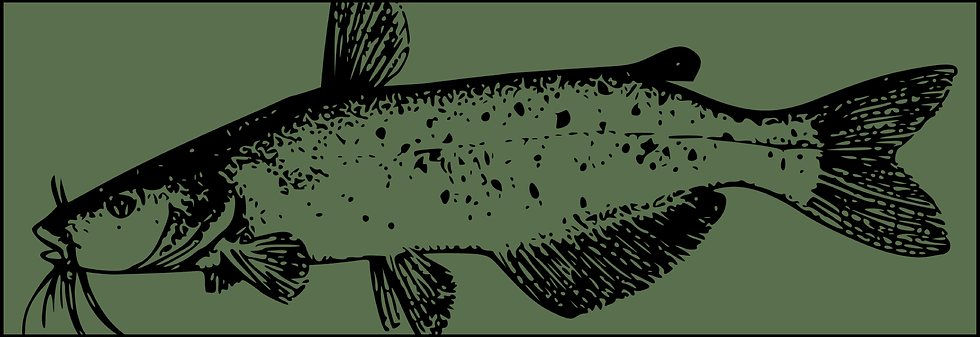
Holding yourself as still as you can, you watch the old catfish out of the corner of your eye as it noses its way out of the thick tangle of muskgrass that carpets the pond floor. You think of it as old, anyways. Ancient, maybe. Primordial. But you have no real idea if that’s true or not, or even what passes for old for a fish. At barely fifteen, you might be the old one here.
It’s huge, though, nearly as long as your whole leg would be if you were to unfold it and stretch it out in front of yourself. Faded scars trace their way across the top of its head and up and down its mottled sides.
And it’s got those long catfish whiskers, so it seems old to you, even if maybe it’s not.
Your grandfather who—like your father—you never met, always wore a long, scraggly beard. That’s what your mother told you. And he could stay underwater the whole day if he wanted, she said, which he often did. In the evenings when she was little, she would climb up into his lap and bury her face in that beard and take great, deep breaths of the green, algae smell it always carried with it. The smell of the lake near to the little house where she grew up.
You think of that whenever you catch a glimpse of the catfish down deep in the pond, even though catfish whiskers don’t look much like real whiskers at all. Still, in your head you’ve named the fish ‘grandad,’ the old man of the pond, and you wish you could be more like either of them and stay down here as long as you wanted. Stay down here forever.
Down here, everything is still. The cloud of silt you stirred up when you first sat down has mostly cleared, and what little that hasn’t is so fine it just hangs there in the water around you.
Even old grandad is frozen in place, now half in, half out of the muskgrass.
Only the sunlight breaks the illusion that time has somehow come to a stop as it ripples in waves across the carpet of green, across the blue-gray of the catfish, across the bits and pieces of yourself you can see.
That, and the tiny prickles of light—sparklers, you call them—that swim around the edges of your vision, telling you you’ve been here too long, that soon you’ll need to roll away the stone from your lap and let yourself float back up for air.
You turn your head—only a little, and as carefully as you can—towards where the catfish has, without ever seeming to move, emerged the rest of the way from the shelter and safety of the muskgrass.
But it sees you move.
Or it senses you somehow.
Or maybe it’s just a coward who can’t stand being out in the open.
In a blink, it turns tail and disappears back under cover, gone so quickly it might never have been anything more than your imagination.
You wonder what makes it such a skittish thing, always afraid. Fish are supposed to have short memories and how can you be frightened if you can’t remember any of the things that might have, once upon a time, scared you in the first place?
Or was it just born this way?
Alone now—you know the catfish won’t show itself again for a long time after being spooked—you look up at the sky above the pond.
You recognize the familiar things you see there, the reds and oranges. The browns of the empty branch hanging out over the pond. The brilliant white and blue of the clouds and sky above it all. But—warped through the lens of the water—it’s dark around the outside as if you’re looking up from the bottom of a deep well. Everything seems farther away than it should. Distorted. Bent and twisted into funhouse mirror shapes.
Nothing up there is as clear as it is beneath the surface.
Around the edges of your vision, the sparklers close in, thicker and more insistent, telling you that you’re at your limit. Past your limit.
You rest your hand on the stone that holds you there. You only need to push it away.
You wish you could be like a catfish—like old grandad. Or more like your own grandfather who could stay down under the water all day if he wanted.
That’s what you want. To hide amongst the muskgrass where no one will know where you are, and no one will ever find you.
You want to have no memory.
You want . . .
Alan P. Marks is a writer/educator from Maine. He teaches at the University of Maine, where he received his Master’s in Creative Writing (longer ago than he likes to admit). More recently, he earned his MFA in Creative Writing from the Stonecoast Program at the University of Southern Maine. He writes mostly horror but also dabbles in more mainstream/literary fiction. He has been published in places including Sunspot Literary Journal, New England Horror Writers, Dead Fox Publishing, and more. His novelette, “Uncertainty Principles,” was released by Paper Angel Press late last year. He’s still working on that elusive first novel.